• 1 of 100 Stories •
By Settle Monroe, Class of 2000
By the late 1920s, Raleigh was changing quickly. Neighborhoods were expanding beyond the city center. Families were settling farther north and west, and the city’s schools were struggling to keep pace with a growing student population. Hugh Morson High School, Raleigh’s existing public high school located on Morgan Street, had become overcrowded as more students entered the school system each year. City leaders knew Raleigh needed something larger. It needed a new kind of high school built not just for the present moment, but for the city Raleigh was becoming.
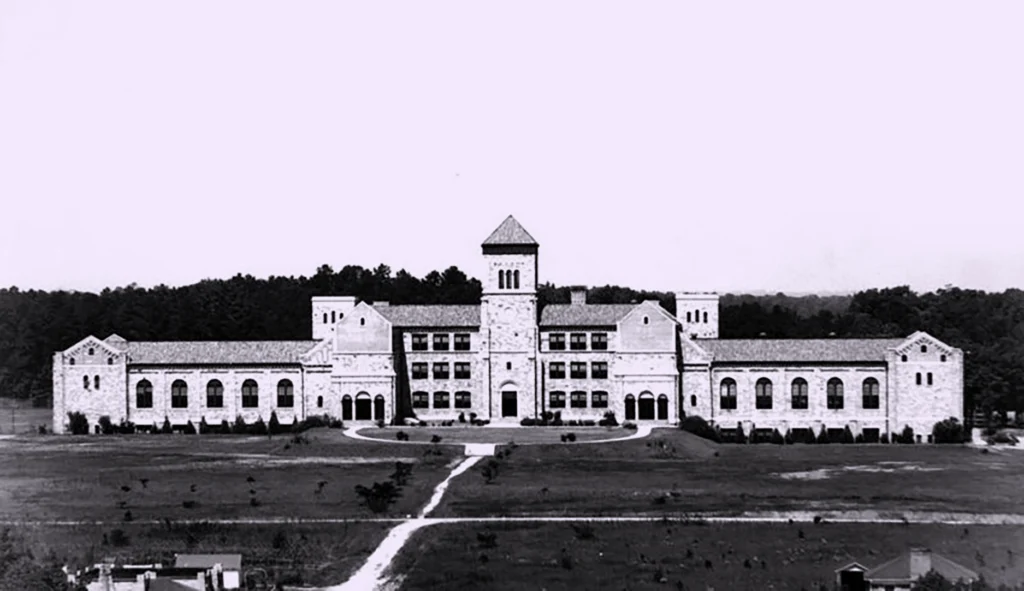
What began as Raleigh’s “New High School” would eventually become one of the city’s most enduring landmarks: Needham B. Broughton High School.
In response to the city’s rapid growth, the Raleigh school board launched plans for a new high school in the expanding northwestern section of the city. The project reflected Raleigh’s growing investment in public education during the early twentieth century and the belief that schools should not only educate students, but also serve as lasting civic spaces for the community itself.
To bring that vision to life, the city held an architectural design competition for the new school. Architect William Henley Deitrick won with a design that immediately stood apart. Inspired by Northern Italian Romanesque architecture, the building featured warm orange brick, carved stone details, sweeping arches, and a dramatic 95-foot tower that could be seen from across Raleigh. The school was constructed at the corner of Peace and St. Mary’s Streets, where it still stands today. When the building opened in 1929, it represented more than additional classroom space. It symbolized Raleigh’s confidence in its future.
Not long after opening, community leaders proposed naming the new school after Needham Bryant Broughton, a Raleigh businessman, civic leader, and longtime supporter of public education.
Born in Wake County in 1848, Broughton came to Raleigh as a child and eventually built a successful printing business, Edwards & Broughton Printing Company, which became one of the state’s leading publishing firms. Alongside his business career, he devoted much of his life to education and civic improvement. He served as the first chairman of Raleigh’s public school board and worked tirelessly to strengthen and support the city’s schools during a period of tremendous growth and change. He also advocated for higher education institutions in Raleigh, including what would later become NC State University.
Following Broughton’s death in 1914, his longtime business partner, C. B. Edwards, wrote to the Raleigh Public School Board asking that the city’s new high school be named in his honor. The request reflected the deep respect many in Raleigh held for Broughton’s commitment to education and public service. In 1930, the school was officially renamed Needham B. Broughton High School.
From the beginning, Broughton High School was designed to meet the needs of a growing city. Its large campus, prominent location, and ambitious design reflected Raleigh’s belief in the importance of public education and its hope for future generations. Over time, the school has become woven into the story of Raleigh itself, a place where students gather not only to learn, but also to build traditions, friendships, and a shared sense of community.
Nearly one hundred years later, many things about Raleigh have changed. The city has grown far beyond what its leaders in 1929 could have imagined. Yet Broughton still stands at the corner of Peace and St. Mary’s Streets, continuing the purpose for which it was first created: to serve the students of a growing and evolving city. What began as Raleigh’s “New High School” has become one of its most recognizable and beloved institutions, a testament to Raleigh’s enduring belief in public education and the opportunities it creates. For nearly a century, generations of students have passed beneath the tower carrying with them dreams, talents, questions, and possibilities. In many ways, the story of Broughton is also the story of what strong public schools make possible for a community, a city, and its future.
Sources:
Benjamin, Karen. “Suburbanizing Jim Crow: The Impact of School Policy on Residential Segregation in Raleigh.” Journal of Urban History, vol. 38, no. 2, 2012, https://doi.org/10.1177/0096144211427114.
Historical Raleigh. With Sketches of Wake County (from 1771) and Its Important Towns; Descriptive, Biographical, Educational, Industrial, Religious. 1913.
Hunicutt, Fab. “Urges Central Location for High School.” Letter to the editor. News and Observer, 24 July 1922.
“New School Site Hearing Public.” News and Observer, 25 July 1922.
Newell, Charles A., Jr. “Broughton, Needham Bryant.” NCpedia, Library of NC, 1979.
“Proposed High School Site Draws Numerous Protests.” News and Observer, 23 July 1922.
“School Board Votes for Sites for Two High Schools.” Raleigh Times, 14 May 1923.
I am a graduate of the Class of 1962. I can remember lyrics of one of the cheerleading songs changing during my years 1959-1962 from, “Cheer Raleigh High School, Raleigh’s the best…” to “Cheer Broughton High School, Broughton’s the best…”
Thanks for sharing this memory, Karen! 💜💛