• 3 of 100 Stories •
by Avery Levine and Olivia Martin, Class of 2028
On Monday, February 10, 1958 Dr. Martin Luther King, Jr. spoke about racial justice at Broughton High School. It would be two years later, in 1960, that William Campbell began attending Murphey Elementary School, marking the start of integration in then Raleigh City Schools, and three years later in 1961, that three women— Myrtle Capehart, Dorothy Howard, and Cynthia Williams— became the first three African American students to attend Broughton.
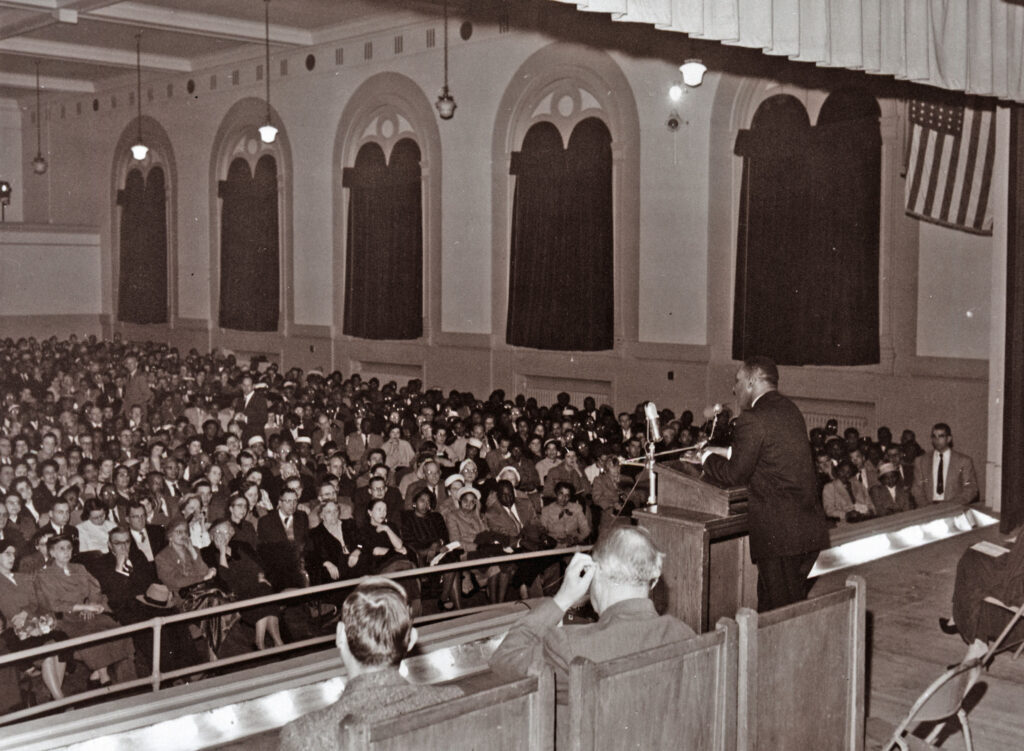
Martin Luther King, Jr., speaking at Broughton High School, Raleigh, NC, 1958. From the General Negative Collection, State Archives of North Carolina (N_82_10_5 MLK Broughton).
Dr. King’s stop in Raleigh was part of a broader speaking tour throughout the South and across the country, where he visited churches, schools, and community organizations to promote nonviolent resistance and encourage support for the Civil Rights Movement. At the time of King’s 1958 visit, Raleigh and Broughton High School generally reflected the intense and complicated reality of segregation as southern school districts were slow to respond to the Supreme Court’s 1954 Brown v. Board of Education ruling.
By 1958, King had become a rising national leader of the Civil Rights Movement. He was well known for leading the Montgomery Bus Boycott, which successfully challenged segregated public transportation, and had co-founded the Southern Christian Leadership Conference, which organized nonviolent campaigns for civil rights across the South. Five years more would pass before the texts so many of us have studied at Broughton— his 1963 “Letter from Birmingham Jail” and “I Have a Dream” speech— emerged.
When King visited Broughton, he was focused on ending racial segregation, protecting voting rights, and encouraging Americans to confront injustice through peaceful resistance rather than violence. Many of Raleigh’s civic and religious leaders were encouraging peaceful discussions over public conflict, and a desire for change helped make King’s appearance possible. Local churches and organizations worked together to host Dr. King, and it was the anticipated attendance that led them to Broughton, where an integrated audience of over 1,700 gathered to hear him speak. King’s goal was to spread his message of nonviolent resistance, racial justice, and equality while encouraging communities across the south to challenge segregation peacefully: “Integration will never be a reality until such a time comes that all men understand and trust each other,” Dr. King said. This pivotal moment connected Raleigh to the broader Civil Rights Movement.
“Integration will never be a reality until such a time comes that all men understand and trust each other.”
Dr. Martin Luther King, Jr.
Source:
- Lewis, T. 1958, February 13. “Dr. King Urges Passive Resistance for Negroes.” The Technician.
Additional reporting:
- Brown, J. (Host). (2026, February 23). MLK comes to Raleigh in the midst of a family’s fight for integration [Television broadcast]. In WTVD Eyewitness News. ABC 11.
- Moore, Jamaul. 2023, September. “Marking History: Civil Rights Milestones Across North Carolina.” Walter magazine.