
• 3 of 100 Stories •
by Avery Levine and Olivia Martin, Class of 2028
Dr. Martin Luther King, Jr. Visited Broughton High School
On Monday, February 10, 1958 Dr. Martin Luther King, Jr. spoke about racial justice at Broughton High School. It would be two years later, in 1960, that William Campbell began attending Murphey Elementary School, marking the start of integration in then Raleigh City Schools, and three years later in 1961, that three women— Myrtle Capehart, Dorothy Howard, and Cynthia Williams— became the first three African American students to attend Broughton.
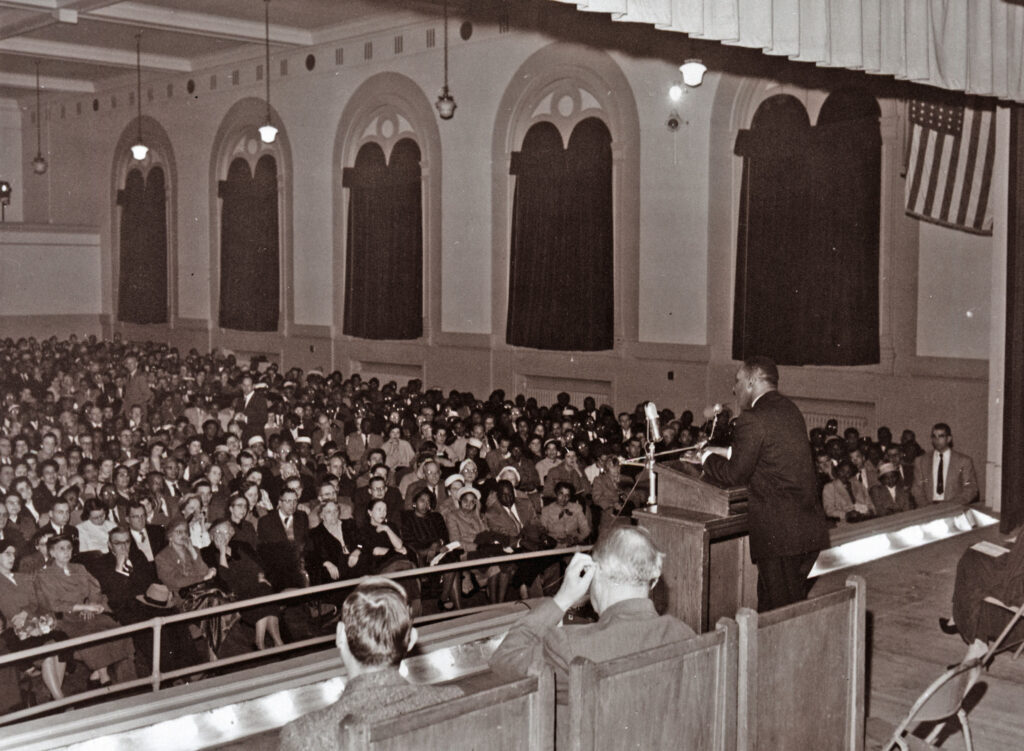
Martin Luther King, Jr., speaking at Broughton High School, Raleigh, NC, 1958. From the General Negative Collection, State Archives of North Carolina (N_82_10_5 MLK Broughton).
Dr. King’s stop in Raleigh was part of a broader speaking tour throughout the South and across the country, where he visited churches, schools, and community organizations to promote nonviolent resistance and encourage support for the Civil Rights Movement. At the time of King’s 1958 visit, Raleigh and Broughton High School generally reflected the intense and complicated reality of segregation as southern school districts were slow to respond to the Supreme Court’s 1954 Brown v. Board of Education ruling.
By 1958, King had become a rising national leader of the Civil Rights Movement. He was well known for leading the Montgomery Bus Boycott, which successfully challenged segregated public transportation, and had co-founded the Southern Christian Leadership Conference, which organized nonviolent campaigns for civil rights across the South. Five years more would pass before the texts so many of us have studied at Broughton— his 1963 “Letter from Birmingham Jail” and “I Have a Dream” speech— emerged.
When King visited Broughton, he was focused on ending racial segregation, protecting voting rights, and encouraging Americans to confront injustice through peaceful resistance rather than violence. Many of Raleigh’s civic and religious leaders were encouraging peaceful discussions over public conflict, and a desire for change helped make King’s appearance possible. Local churches and organizations worked together to host Dr. King, and it was the anticipated attendance that led them to Broughton, where an integrated audience of over 1,700 gathered to hear him speak. King’s goal was to spread his message of nonviolent resistance, racial justice, and equality while encouraging communities across the south to challenge segregation peacefully: “Integration will never be a reality until such a time comes that all men understand and trust each other,” Dr. King said. This pivotal moment connected Raleigh to the broader Civil Rights Movement.
“Integration will never be a reality until such a time comes that all men understand and trust each other.”
Dr. Martin Luther King, Jr.
Source:
- Lewis, T. 1958, February 13. “Dr. King Urges Passive Resistance for Negroes.” The Technician.
Additional reporting:
- Brown, J. (Host). (2026, February 23). MLK comes to Raleigh in the midst of a family’s fight for integration [Television broadcast]. In WTVD Eyewitness News. ABC 11.
- Moore, Jamaul. 2023, September. “Marking History: Civil Rights Milestones Across North Carolina.” Walter magazine.
I was unaware that MLK ever spoke at our alma mater. I was in the fifth grade at Francis Lacy Elementary school in 1958. The FBI surveillance files on King were sealed on 1 January 1977, slated to be opened in a couple of months: 1 January, 2027. Will they be sealed further to protect the memory of Saint Martin? We’ll see.
It may finally be time to look at how the civil rights social experiment of government-enforced racial integration has worked out.
…On Labor Day, 1957, a special meeting was attended by Martin Luther King and four others at a strange institution called the Highlander Folk School in Monteagle, Tennessee. The Highlander Folk School was a Communist front, having been founded by Myles Horton (Communist Party organizer for Tennessee) and Don West (Communist Party organizer for North Carolina). The leaders of this meeting with King were the aforementioned Horton and West, along with Abner Berry and James Dumbrowski, all open and acknowledged members of the Communist Party, USA. The agenda of the meeting was a plan to tour the Southern states to initiate demonstrations and riots.
From 1955 to 1960, Martin Luther King’s associate, advisor, and personal secretary was one Bayard Rustin. In 1936 Rustin joined the Young Communist League at New York City College. Convicted of draft-dodging, he went to prison for two years in 1944. On January 23, 1953 the Los Angeles Times reported his conviction and sentencing to jail for 60 days for lewd vagrancy and homosexual perversion. Rustin attended the 16th Convention of the Communist Party, USA in February, 1957. One month later, he and King founded the Southern Christian Leadership Conference, or SCLC for short. The president of the SCLC was Dr. Martin Luther King, Jr. The vice-president of the SCLC was the Reverend Fred Shuttlesworth, who was also the president of an identified Communist front known as the Southern Conference Educational Fund, an organization whose field director, a Mr. Carl Braden, was simultaneously a national sponsor of the Fair Play for Cuba Committee, of which you may have heard. The program director of the SCLC was the Reverend Andrew Young, in more recent years Jimmy Carter’s ambassador to the UN and mayor of Atlanta. Young, by the way, was trained at the Highlander Folk School, previously mentioned.
Soon after returning from a trip to Moscow in 1958, Rustin organized the first of King’s famous marches on Washington. The official organ of the Communist Party, The Worker, openly declared the march to be a Communist project. Although he left King’s employ as secretary in 1961, Rustin was called upon by King to be second in command of the much larger march on Washington which took place on August 28, 1964.
Bayard Rustin’s replacement in 1961 as secretary and advisor to King was Jack O’Dell, also known as Hunter Pitts O’Dell. According to official records, in 1962 Jack O’Dell was a member of the National Committee of the Communist Party, USA. He had been listed as a Communist Party member as early as 1956. O’Dell was also given the job of acting executive director for SCLC activities for the entire Southeast, according to the St. Louis Globe-Democrat of October 26, 1962. At that time, there were still some patriots in the press corps, and word of O’Dell’s party membership became known.
What did King do? Shortly after the negative news reports, King fired O’Dell with much fanfare. And he then, without the fanfare, immediately hired him again as director of the New York office of the SCLC, as confirmed by the Richmond News-Leader of September 27, 1963….