A Mystery Guest Visits Broughton

• 4 of 100 Stories •

by Diane Payne, Principal of BHS from 1991 to 2005


One of the outstanding leaders of our country told our students about the importance of service and how fortunate they should feel to have the opportunity, as high school students, to give back. 


In early February 1994, Superintendent Bill McNeal called me and said a special person would be in Raleigh that month and wanted to meet with a small group of students.  He would not tell me who the person was, saying the guest didn’t want a lot of publicity.

I told the superintendent it would be very difficult to choose just 25 students for this very special meeting. I suggested we have an assembly in the gym so all the students could hear him.  Although the superintendent wasn’t at all confident the guest would agree, he said he would ask and let me know.

To our mutual surprise and delight, the special guest agreed to meet with the entire school! The superintendent still wouldn’t tell me the name of the guest!

On February 22, 1994, all Broughton High School students and faculty reported to the gym for an assembly with a special guest whose name they did not know. Of course, there was speculation and excitement about the mystery guest!

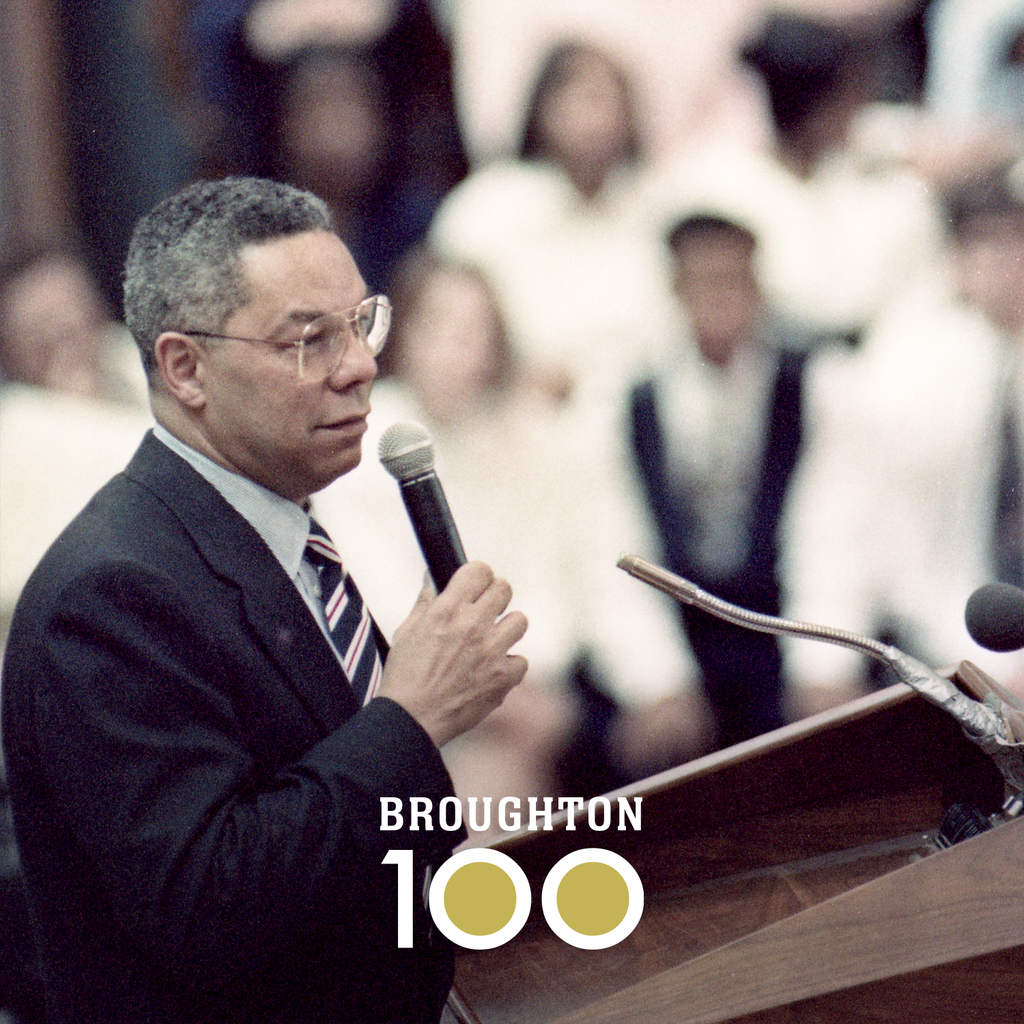
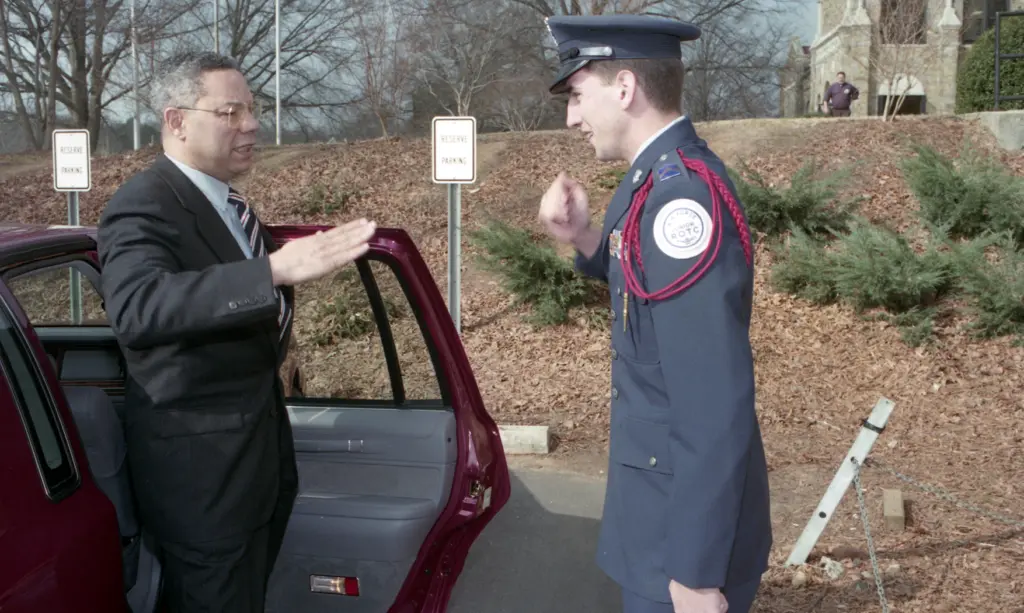
Colin Powell, the 12th chairman of the Joint Chiefs of Staff, and later the 65th Secretary of State, arrived at Broughton, and we met in my office to discuss the plan for the assembly. Suddenly, Colin Powell’s nose started bleeding! We tried numerous ways to stop the nosebleed, but without success. As the minutes went on, I thought about the fact that we had a guest whose nose would not stop bleeding and 2100 students in the gym waiting with anticipation! What should we do?
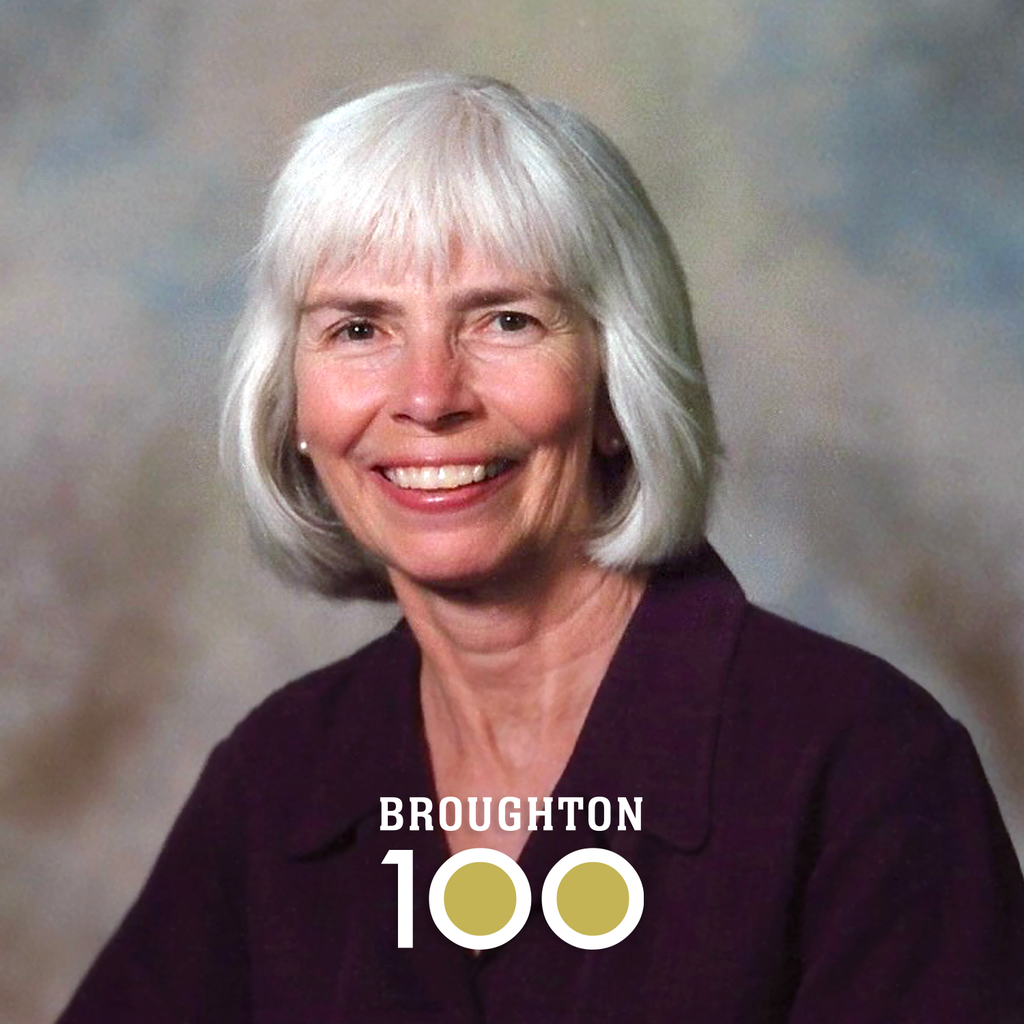
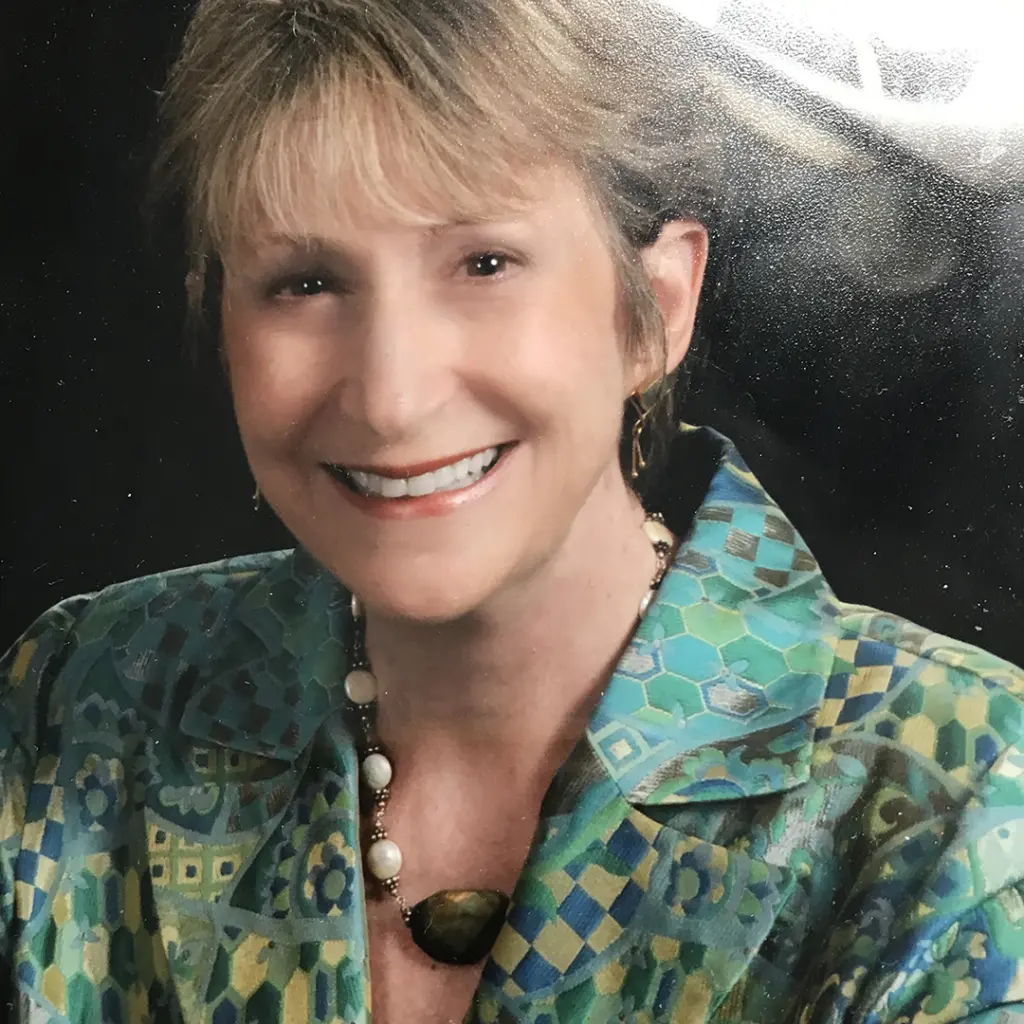
Principal Diane Payne
General Colin Powell

Although disappointed, I told Colin Powell that we would cancel the assembly. I told him that his health was the most important consideration and assured him the students and staff would understand. Colin Powell said he wanted to wait a few more minutes before canceling; he didn’t want to disappoint the students. Thankfully, his nose finally stopped bleeding! 

We walked into the gym as the band played patriotic music, and the audience stood up and applauded when they saw that the special guest was Colin Powell! The students were spellbound as he made his remarks. And then Colin Powell asked the students if they had any questions for him! 

The students asked excellent, thought-provoking questions, but the final question gave me pause. A student asked what he thought of requiring students to perform community service as a graduation requirement. (The school board had recently approved our request to require students to perform 25 hours of community service each year they attended Broughton. Not every student was thrilled with the additional requirement!) 

Colin Powell told students he was a strong proponent of community service and gave compelling reasons why students should willingly give back to their community. One of the outstanding leaders of our country told our students about the importance of service and how fortunate they should feel to have the opportunity, as high school students, to give back. 

February 22, 1994, was a very special day for Broughton High School and one I will never forget. We were honored to have a man who has given so much to our country take the time to speak with our students. 

Several days after his visit, I received a handwritten note from Colin Powell thanking me for allowing him to talk to our students! Of course, I still have the note and will treasure it always! 

Thank you, Colin Powell!


The community service program at Broughton High School was established during the 1994–1995 school year under the leadership of Diane Payne, Principal; Sandra Coats, Teacher; and Jayne VanGraafeiland, Coordinator, Community Service Program. The program is designed to teach citizenship skills and the value of serving others. 

Students must complete 25 hours of community service each academic year they are enrolled at Broughton. Hours must be performed with a non-profit agency, a registered 501(c)(3), such as public schools, public libraries, food banks, or other civic organizations.

Each year, Broughton students provide thousands of hours of community service both on campus as well as in the surrounding community through a combination of hands-on projects and donations. Homecoming Week sees the Broughton community supporting the Food Bank of Central and Eastern North Carolina’s Students Against Hunger. January sees the Broughton community come together and support the Kay Yow Cancer Fund with a Play 4 Kay event. Caps for the Community Club spearheads the Queen of Hearts fundraiser each year, letting the student body vote on which local organization will benefit. 

Dr. Martin Luther King, Jr. Visited Broughton High School

• 3 of 100 Stories •

by Avery Levine and Olivia Martin, Class of 2028

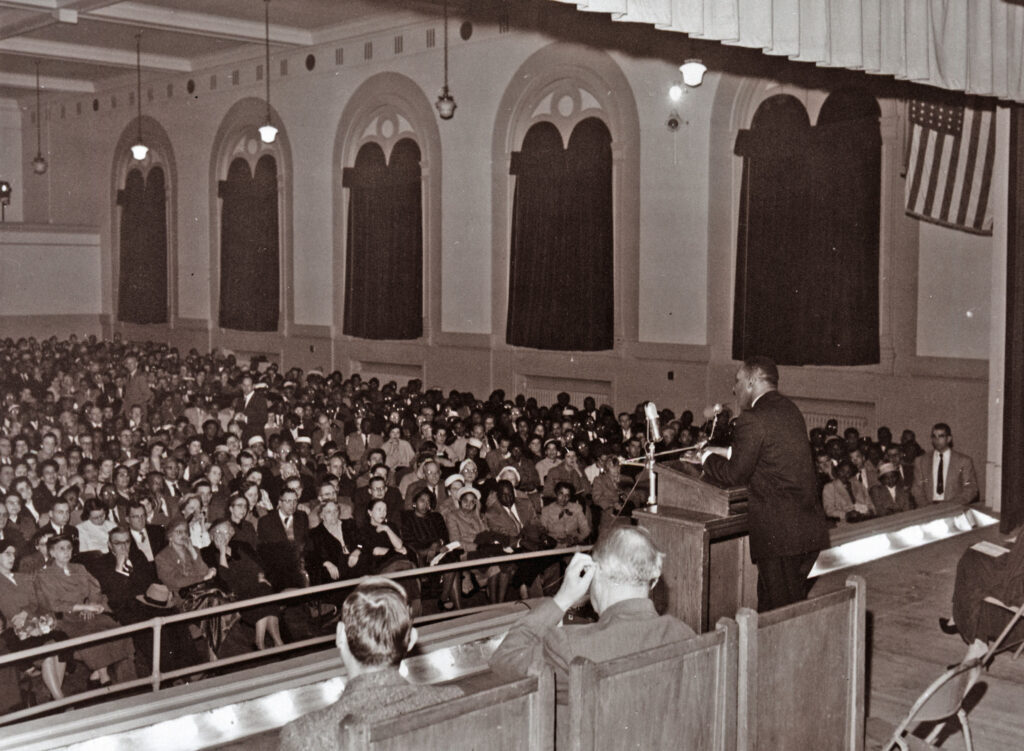
On Monday, February 10, 1958 Dr. Martin Luther King, Jr. spoke about racial justice at Broughton High School. It would be two years later, in 1960, that William Campbell began attending Murphey Elementary School, marking the start of integration in then Raleigh City Schools, and three years later in 1961, that three women— Myrtle Capehart, Dorothy Howard, and Cynthia Williams— became the first three African American students to attend Broughton.


Martin Luther King, Jr., speaking at Broughton High School, Raleigh, NC, 1958. From the General Negative Collection, State Archives of North Carolina (N_82_10_5 MLK Broughton).


Dr. King’s stop in Raleigh was part of a broader speaking tour throughout the South and across the country, where he visited churches, schools, and community organizations to promote nonviolent resistance and encourage support for the Civil Rights Movement. At the time of King’s 1958 visit, Raleigh and Broughton High School generally reflected the intense and complicated reality of segregation as southern school districts were slow to respond to the Supreme Court’s 1954 Brown v. Board of Education ruling.

By 1958, King had become a rising national leader of the Civil Rights Movement. He was well known for leading the Montgomery Bus Boycott, which successfully challenged segregated public transportation, and had co-founded the Southern Christian Leadership Conference, which organized nonviolent campaigns for civil rights across the South. Five years more would pass before the texts so many of us have studied at Broughton— his 1963 “Letter from Birmingham Jail” and “I Have a Dream” speech— emerged. 

When King visited Broughton, he was focused on ending racial segregation, protecting voting rights, and encouraging Americans to confront injustice through peaceful resistance rather than violence. Many of Raleigh’s civic and religious leaders were encouraging peaceful discussions over public conflict, and a desire for change helped make King’s appearance possible. Local churches and organizations worked together to host Dr. King, and it was the anticipated attendance that led them to Broughton, where an integrated audience of over 1,700 gathered to hear him speak. King’s goal was to spread his message of nonviolent resistance, racial justice, and equality while encouraging communities across the south to challenge segregation peacefully: “Integration will never be a reality until such a time comes that all men understand and trust each other,” Dr. King said. This pivotal moment connected Raleigh to the broader Civil Rights Movement.

“Integration will never be a reality until such a time comes that all men understand and trust each other.”

Dr. Martin Luther King, Jr.

Source:

  1. Lewis, T. 1958, February 13. “Dr. King Urges Passive Resistance for Negroes.” The Technician.

Additional reporting:

  1. Brown, J. (Host). (2026, February 23). MLK comes to Raleigh in the midst of a family’s fight for integration [Television broadcast]. In WTVD Eyewitness News. ABC 11.
  2. Moore, Jamaul. 2023, September. “Marking History: Civil Rights Milestones Across North Carolina.Walter magazine.

The Impact of That Special Broughton Teacher

• 2 of 100 Stories •

by Katherine Snow Smith, Class of 1986

Whether they were an academic star or someone who listed study hall as their favorite subject, every Broughton High School student had at least one teacher who saw their unique strengths, ignited an interest, and left a lasting mark. 

For this second of 100 blog posts counting up to Broughton’s centennial, I interviewed three English teachers whom many alums recall as that standout instructor. 


Babs Nichols, who started at Broughton in 1985, will be welcoming students again in the fall for her forty-second school year. In 2014, The Huffington Post shared her essay on why she continues teaching with a national audience. 

“I stay because I laugh and learn every day. Your children are funny, insightful, and brutally honest. If my shoes don’t match my outfit, they tell me. If my argument that Invisible Man is an important twentieth century classic doesn’t convince them, they tell me,” she wrote. 

Her dedication to students is a hallmark. When she grades a paper, Ms. Nichols covers it with comments — not just corrections but more so with detailed reactions and insightful questions. She fosters academic success as well as students’ wellbeing.

“I will find myself often saying things like: ‘Make sure you go outside every day. Make sure you get some sleep. Make sure you get some exercise,’ ” she says. Her tenure at Broughton gives her a perspective of what’s endured and all that has changed — from students’ perceptions to the impact of cell phones. 

“I’ve taught The Great Gatsby 41 times,” she says. “In 1985, a lot of kids thought Jay Gatsby was very romantic with his obsession with Daisy. In 2025 they’re like: ‘That dude was a stalker.’” 

As technology, from Grammarly to AI, lessens the need for students to master the intricacies of grammar, prescribed curricula place less emphasis on it. While most teachers address it as needed within the bigger context of writing, Nichols calls herself a “dinosaur” for still teaching designated grammar lessons. She knows it’s essential for acing college entrance exams and competing for competitive schools and scholarships. 

Ms. Nichols has shared big and small milestones with her students. She felt the unanimous pride when Broughton hosted its first home football game and saw the advent of the block schedule, the new science wing, and the breathalyzer at Queen of Hearts. 

With a flatscreen TV in every classroom, many teachers turned on the live coverage of 9/11. At first it seemed like a horrible accident and Nichols continued teaching, but after the second plane hit the South Tower, all eyes were fixed on the screen. 

“We watched the second tower collapse,” she recalls. “You could hear a pin drop.” 


Sylvia White, who taught English at Broughton 1984 to 1987, made such an impact on students she was named Wake County Teacher of the Year and NC English Teacher of the Year.

I was one of those students. It was in Ms. White’s class that I learned to question authors’ motives and society’s expectations as well as question Ms. White and myself. A friend recently told me she kept her maiden after marrying because that’s what Ms. White did. 

“I had always been insulted by how women became ‘Mrs. Edward Jones,’ for example. Not only did they lose their last name, but their first name too,” Ms. White says. “In graduate school I studied British law and learned women were considered property. As ‘Miss,’ you were property of your father and ‘Mrs.’ designated you were property of your husband.”

She says she always strived to relate to students on their level and build trust. She showed us how Wuthering Heights, a 1700s romance on the foggy moors of England, still resonated with modern life centuries later by playing Pat Benatar’s hauntingly beautiful song by the same name. (I found it online for my daughters when they read the book.)

“One of my main goals was to foster a love of reading,” she says. “I often used journaling prompts. If a book was about personal challenges, I’d have students write for 15 minutes about their own personal challenges.” Journaling was a key part of her approach to make us better writers. We had assigned topics as well as the freedom to write about anything. 

“I didn’t grade on the quality of the writing, but the process. They would turn in their journals and they could choose three different entries they didn’t want me to read and turn down the corners and I promised not to look,” she says. 

At the end of senior year she assigned us the task of writing letters to our future selves including our hopes and concerns as we were leaving high school. Five years later we received each letter in the mail.

“I thought it would be cool for these children coming into adulthood to read a letter from their childhood self,” she says. 

When I received my letter a year after college graduation and already into my second job, I saw my priorities that had changed and what endured. I remember thinking how different my life was already from what I predicted just five years earlier. But that was okay. I think Ms. White was still trying to teach me something important, something that still serves me today.


My mother, Nancy Snow, taught English, public speaking, and drama at Broughton from 1958 to 1964. For decades, whenever I meet one of her former students, including parents of my classmates, they say she was a favorite teacher. Many give her credit for becoming a confident public speaker, which enabled career success.

In the early 1960s, Raleigh began slowly integrating schools through a gradual “freedom of choice” plan. Broughton’s principal, Joseph Holliday, asked my mother and a few other hand-selected teachers if they would be willing to teach Black students.

“I said: ‘Of course.’ Most of us did. One math teacher he asked said she wouldn’t teach them,” my mother, age 94, recalls. “It was heroic of these students to come to Broughton.”

Mrs. Snow is also known for directing some of Broughton’s first full-scale musicals, including Oklahoma in 1962. A sold-out crowd paying $1 a ticket filled the auditorium two nights in a row. The production received a two-page spread of coverage in The Raleigh Times.

“The wonderful thing was everybody was involved. The phys-ed teacher worked with the girls on the dance for ‘Everything Is Up To Date in Kansas City.’ We had a wonderful music teacher, Mrs. Freeman. The wife of someone who worked in the office played the piano,” she says. “Students painted sets. Mothers made costumes. Our friend Grady Cooper knew somebody in Durham with a surrey with a fringe on top and he let us borrow it.”

My parents hosted a party for all students and faculty involved after the show at their new home in Brookhaven. It was the first integrated gathering in the all-white neighborhood.

I’ve also heard former students recount sitting in Mrs. Snow’s class on November 22 when Mr. Holliday announced through the wooden intercom speaker over the chalkboard that President Kennedy had been shot in Dallas and was dead.

Mrs. Snow cried, as did many students — male and female. She walked over to the bookshelf and pulled out a volume of A.E. Housman poetry, then read “To An Athlete Dying Young.” 

The six-stanza poem begins with: 

The time you won your town the race

We chaired you through the market-place;

Man and boy stood cheering by,

And home we brought you shoulder-high.

Today the road all runners come,

Shoulder-high we bring you home

And set you at your threshold down,

Townsman of a stiller town…” 1


Source:

  1. The Norton Anthology of Poetry Third Edition (1983)

A Century Begins: The Early Story of Broughton High School

• 1 of 100 Stories •

By Settle Monroe, Class of 2000

By the late 1920s, Raleigh was changing quickly. Neighborhoods were expanding beyond the city center. Families were settling farther north and west, and the city’s schools were struggling to keep pace with a growing student population. Hugh Morson High School, Raleigh’s existing public high school located on Morgan Street, had become overcrowded as more students entered the school system each year. City leaders knew Raleigh needed something larger. It needed a new kind of high school built not just for the present moment, but for the city Raleigh was becoming. 

What began as Raleigh’s “New High School” would eventually become one of the city’s most enduring landmarks: Needham B. Broughton High School. 

In response to the city’s rapid growth, the Raleigh school board launched plans for a new high school in the expanding northwestern section of the city. The project reflected Raleigh’s growing investment in public education during the early twentieth century and the belief that schools should not only educate students, but also serve as lasting civic spaces for the community itself. 

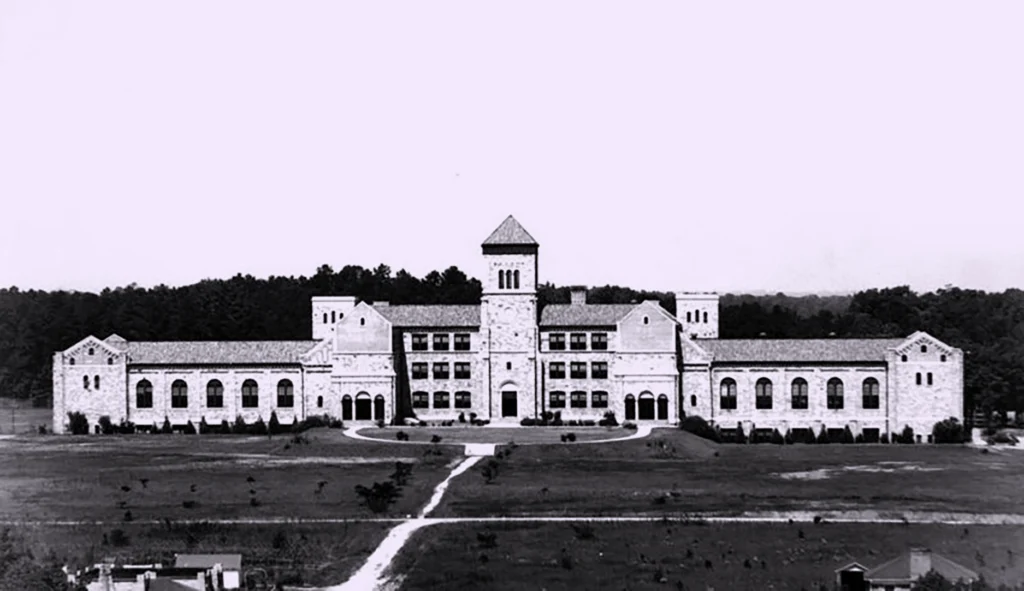
To bring that vision to life, the city held an architectural design competition for the new school. Architect William Henley Deitrick won with a design that immediately stood apart. Inspired by Northern Italian Romanesque architecture, the building featured warm orange brick, carved stone details, sweeping arches, and a dramatic 95-foot tower that could be seen from across Raleigh. The school was constructed at the corner of Peace and St. Mary’s Streets, where it still stands today. When the building opened in 1929, it represented more than additional classroom space. It symbolized Raleigh’s confidence in its future. 

Not long after opening, community leaders proposed naming the new school after Needham Bryant Broughton, a Raleigh businessman, civic leader, and longtime supporter of public education. 

Born in Wake County in 1848, Broughton came to Raleigh as a child and eventually built a successful printing business, Edwards & Broughton Printing Company, which became one of the state’s leading publishing firms. Alongside his business career, he devoted much of his life to education and civic improvement. He served as the first chairman of Raleigh’s public school board and worked tirelessly to strengthen and support the city’s schools during a period of tremendous growth and change. He also advocated for higher education institutions in Raleigh, including what would later become NC State University. 

Following Broughton’s death in 1914, his longtime business partner, C. B. Edwards, wrote to the Raleigh Public School Board asking that the city’s new high school be named in his honor. The request reflected the deep respect many in Raleigh held for Broughton’s commitment to education and public service. In 1930, the school was officially renamed Needham B. Broughton High School. 

From the beginning, Broughton High School was designed to meet the needs of a growing city. Its large campus, prominent location, and ambitious design reflected Raleigh’s belief in the importance of public education and its hope for future generations. Over time, the school has become woven into the story of Raleigh itself, a place where students gather not only to learn, but also to build traditions, friendships, and a shared sense of community. 

Nearly one hundred years later, many things about Raleigh have changed. The city has grown far beyond what its leaders in 1929 could have imagined. Yet Broughton still stands at the corner of Peace and St. Mary’s Streets, continuing the purpose for which it was first created: to serve the students of a growing and evolving city. What began as Raleigh’s “New High School” has become one of its most recognizable and beloved institutions, a testament to Raleigh’s enduring belief in public education and the opportunities it creates. For nearly a century, generations of students have passed beneath the tower carrying with them dreams, talents, questions, and possibilities. In many ways, the story of Broughton is also the story of what strong public schools make possible for a community, a city, and its future. 


Sources: 

Benjamin, Karen. “Suburbanizing Jim Crow: The Impact of School Policy on Residential Segregation in Raleigh.” Journal of Urban History, vol. 38, no. 2, 2012, https://doi.org/10.1177/0096144211427114

Historical Raleigh. With Sketches of Wake County (from 1771) and Its Important Towns; Descriptive, Biographical, Educational, Industrial, Religious. 1913. 

Hunicutt, Fab. “Urges Central Location for High School.” Letter to the editor. News and Observer, 24 July 1922. 

“New School Site Hearing Public.” News and Observer, 25 July 1922. 

Newell, Charles A., Jr. “Broughton, Needham Bryant.” NCpedia, Library of NC, 1979. 

“Proposed High School Site Draws Numerous Protests.” News and Observer, 23 July 1922. 

“School Board Votes for Sites for Two High Schools.” Raleigh Times, 14 May 1923.